Blog

TODAY I FINISHED WORKING... AND I AM STILL AT HOME.

Son las palabras que con entusiasmo expresan algunas personas que hacen parte del gran número de empleados, que, con ocasión de la pandemia, han tenido que realizar trabajo virtual en casa desde el inicio del COVID19, contribuyendo a la sostenibilidad de las empresas y a conservar sus empleos. Y es que de acuerdo con el “Estudio SPR-MARCO Hábitos de Consumo Post COVID-19”, Portafolio junio 2020, realizado en varios países; en Colombia, “El 80% de los encuestados señaló que les gustaría teletrabajar más en un futuro después de la cuarentena. La pandemia cambió de manera drástica el entorno laboral de las organizaciones, la migración improvisada del trabajo presencial al trabajo remoto, ha generado estrés en los empleados, ocasionado por los desafíos que ha implicado la implementación de nuevas formas de trabajo, pero gracias a la capacidad de adaptación del ser humano, hoy la gran mayoría de las personas que vienen laborando en esta modalidad, coinciden en que les gustaría continuar trabajando en esas condiciones, por los diversos beneficios que han percibido. De acuerdo con la encuesta realizada por The Trust for The Americas, agosto 2020, a empleados de diferentes sectores de la economía en Colombia, el 75% de los encuestados manifiesta que esta modalidad le representa ahorro en tiempo y movilidad a su lugar de trabajo y el 60% coincide en que ahorra en gastos de traslado y sostenimiento. En este contexto, se evidencia algunos beneficios emocionales, por ejemplo: quienes son padres de familia tienen la oportunidad de estar más cerca de sus hijos, participando de manera más activa en el proceso de crianza y formación; para otros, apoyando el cuidado de personas dependientes (adultos mayores o personas con discapacidad), en general, compartiendo con las personas más cercanas, sintiéndose más satisfechos. No obstante, las organizaciones se enfrentan al reto de transformar su cultura al nuevo entorno laboral, si se tiene en cuenta que, esta transición ha dejado claro que el trabajo no se refiere al lugar en que se ejecuta, sino a la tarea que se desarrolla, escenario que obliga a las empresas a pensar y hacer las cosas de manera diferente; los esquemas tradicionales de gestión empresarial, basados en un liderazgo de supervisión y control directo, no se aplican de la misma manera en las relaciones con equipos remotos, cada vez más la comunicación, el autocontrol, la autonomía, iniciativa, y creatividad, entre otros, adquieren un papel definitivo en las nuevas formas organizacionales. La nueva cultura organizacional debe enfocarse a alinear a los colaboradores con las nuevas tendencias de gestión y liderazgo, a orientar el trabajo por resultados, diseñando estrategias motivacionales enfocadas a mantener el compromiso y sentido de pertenencia, a través de un proceso de aprendizaje y reentrenamiento a lo largo  de su vinculación laboral, que permita fortalecer las habilidades y competencias requeridas por las organizaciones, para el cumplimiento de sus objetivos . De todas maneras, la exclamación “Hoy terminé de trabajar…y sigo en casa”, refleja el sentimiento de alegría y satisfacción del deber laboral cumplido, sin salir de casa. 

TODAY I FINISHED WORKING... AND I AM STILL AT HOME. Read More »
Join the Trust for the Americas 2020 End-of-Year Bazaar!

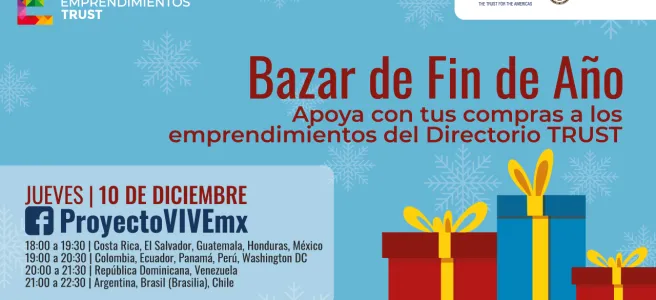
The end-of-year holidays are approaching, and the global crisis caused by COVID-19 has led us to turn to virtual platforms as a tool to continue and expand our projects. In this context, Trust for the Americas aims to highlight the ventures of the individuals we’ve trained through their projects to recognize their efforts and connect them with potential customers during this special time of year.   Below are the requirements to join this special “End-of-Year Bazaar” edition which will take place on December 10, 2020. Participation requirements must be met by November 27, 2020, at the latest. Registration questionnaire. Questions to answer in the video. General introduction to yourself and your venture (elevator pitch) Remember for your pitch For more tips on how to make your video, check out this tutorial in which Ma. Fernanda Barragán, Project VIVE Facilitator, teaches us how to give an elevator pitch.  Submission deadline: Friday, November 27, no later than 12 p.m. (Mexico City time).  *If you don’t have a Facebook page for your startup, ask us about the Proyecto VIVE tutorial. * On the afternoon of Friday, November 27, those selected for the live stream will be contacted.   Fernanda Barragán, Project VIVE Facilitator, will be available to answer any questions or provide clarification. Contact: vcelaya@20.9.190.97 or by phone at 461 275 0968 

Join the Trust for the Americas 2020 End-of-Year Bazaar! Read More »

The Trust for the Americas impulsa a personas emprendedoras en LAC

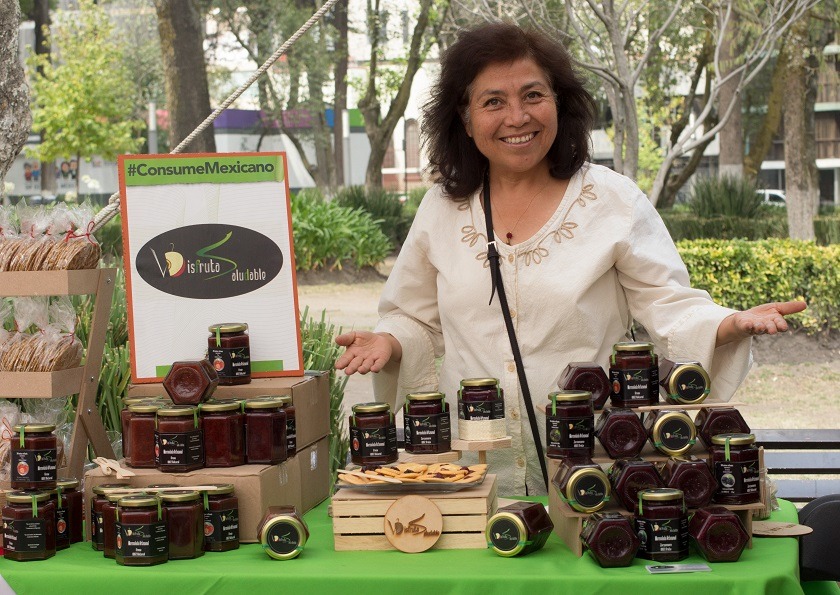
El pasado 24 de septiembre, The Trust for the Americas lanzó el Directorio de Emprendimientos Trust, una iniciativa que busca impulsar los emprendimientos de las personas que se han beneficiado a través de sus diferentes programas. Durante el lanzamiento María Liliana Mor, Directora de Innovación de Negocios y Alianzas Regionales, comentó que “esta nueva herramienta está llena de contactos emprendedores y emprendedoras que han pasado por los proyectos de The Trust for the Amercias, que tendrán la oportunidad de conectarse y sobre todo, aprender sobre los productos que cada una de ellas tiene”. María Liliana recordó que “el Directorio nació de un Proyecto, bellísimo, en México que se llama VIVE: ven, inspírate y vende. Su misión ha sido empoderar a mujeres, ¡a más de 50 mil mujeres!, hemos llegado a más de 70 mil personas con este proyecto. Muchas de estas mujeres en su proceso de capacitación se dieron cuenta que querían emprender y necesitábamos un espacio para visibilizar sus emprendimientos”. En 2019 se lanzó el Directorio de Emprendedoras del Proyecto VIVE, mismo que fue ampliado un año después para registrar a emprendedoras y emprendedores de Latinoamérica y el Caribe. “El Directorio de Emprendimientos Trust busca ampliar el Directorio de Emprendedoras VIVE para generar un espacio colaborativo que recopila información de los emprendimientos generados por personas egresadas de nuestros proyectos de capacitación en América Latina”, explicó el equipo de oportunidades económicas del Proyecto VIVE: Úrsula Sánchez y Elizabeth Laredo. María Fernanda Sierra, Gerente Senior de Proyectos – POETA, agregó que “esta herramienta digital está vinculada al Sistema de Información del Trust, lo que corrobora que las personas registradas sean egresadas de alguno de los programas de The Trust for the Americas”. Actualmenete, el Directorio de Emprendimientos Trust cuenta con un registro de más de 170 personas de México, Colombia, Puerto Rico, República Dominicana y Chile. Para conocer más de esta iniciativa, puede ver el lanzamiento completo en: https://www.youtube.com/watch?v=BptTPDucJSE Si quieres conocer el directorio, puedes visitar: https://bit.ly/2RuaBo4

The Trust for the Americas impulsa a personas emprendedoras en LAC Read More »

La educación del futuro te necesita a ti

Los cambios acelerados que traen consigo los avances tecnológicos, así como el contexto de múltiples transformaciones en el área social, económica y política, sugieren un reenfoque de la educación.   Cada vez más, los trabajos dentro de compañías y en los gobiernos, tienen un claro norte digital. Los lineamientos de confinamiento y distanciamiento social establecidos por los gobiernos alrededor del mundo, han impulsado a su vez el auge del teletrabajo, que en muchos gremios llegó para quedarse. Sin embargo, las escuelas primarias y secundarias siguen presentando deudas con la digitalización y su uso efectivo. Como señala la exministra de Educación guatemalteca, María del Carmen Aceña en Forbes Centroamérica, “es primordial que la cartera educativa redistribuya sus recursos económicos en favor de las nuevas tecnologías, para evitar que los inconvenientes causen deserción de niños y jóvenes de escasos recursos”.  Según Schools of The Future Report (2019), realizado por el World Economic Forum, existen 8 cualidades críticas que permiten distinguir una educación de alta calidad para la Cuarta Revolución Industrial. Una de ellas es la Educación Tecnológica, es decir, “la inclusión de contenidos que se basen en desarrollar habilidades digitales, como programación, responsabilidad digital y el uso de tecnologías”.  Esto con el fin de equiparar las estrategias educativas a otros procesos que las juventudes viven –y vivirán- de manera inevitable al crecer en la sociedad actual, por ejemplo: los nuevos modelos de teletrabajo, el reemplazo de personas por robots o máquinas para realizar distintas tareas, y la capacidad de analizar las problemáticas en su entorno a través del pensamiento lógico-matemático, sin dejar por fuera la inteligencia social y emocional.   El mismo documento, además, señala la importancia de potenciar las alianzas público-privadas para lograrlo, tomando en cuenta a empresas tecnológicas, institutos y ministerios de educación, así como los mismos profesionales en docencia.  Con el objetivo de incentivar este tipo de prácticas, EIDOS se encargará de impartir, el martes 6 de octubre, una capacitación gratuita orientada a docentes. En este taller se explicarán fundamentos básicos de las ciencias de la computación, inteligencia artificial y aprendizaje automático por medio de una actividad de La Hora del Código.  Gracias a oportunidades como esta, docentes de diferentes países hispanohablantes podrán prepararse para el reto que implica la enseñanza durante y después del CoVid-19, que sin duda requerirá el trabajo integral, dinámico y unificado.   ¡La enseñanza del futuro empieza contigo! Ingresa al taller a través del siguiente enlace https://linktr.ee/eidosglobal 

La educación del futuro te necesita a ti Read More »

Creativity Sparks Innovation in Jamaica.

About the Jamaica Pitch Tank Competition Awardees – August 2020. As challenging as these times may be, there is much to be optimistic about. When we look back, we will see not just the human and economic loss inflicted by the virus, but an important gain: a growing global awareness of the value of trust and collaboration. By bringing to a halt most of our used-to-be routines, these challenges forced upon us, changes to the way we work, learn, and relate with one and other. And this brings us closer together to what “trusting” in one another means to Humanity nowadays. Education has shifted and now relies more than ever on trust. If we are still working, successful remote working demands a greater level of trust. Reopening the economy also relies heavily on trust and the way people will collaborate to avoid spreading the virus. Trust in our institutions and societies and in the decisions that our leaders take every day. Trust is the cornerstone of how we contest these given  circumstances and especially how we move forward. So let´s move forward, let´s think about how we can build the future, how are we going to rebuild our societies and at the same time, lay the foundations of a more inclusive economy and a more equal world. According to the World Economic Forum, the lockdown has hurried the arrival of the “future of work”; and despite the challenges of technological disruption and a shift in the structural economic fabric, we must also recognize this moment as an opportunity to better \”re-build back” and lay the foundations of a more inclusive economy and a more equal world. At the Trust for the Americas we are sure we can collaborate in this endeavor by training people (what we call upskilling and re skilling), as well as identifying the opportunities that the jobs of the future will provide to thousands of young people today. But what we are most confident of, is that we will only be able to succeed in building a better and more egalitarian future if we use all our creativity combined with innovative ways of working. Today we made a big step forward in the way Jamaica is going to face that future by identifying dozens of young innovators that have put their creativity and inspiration to work and have reached incredible levels of innovation whilst looking for answers to local and regional challenges. Together with important organizations and partners we identified dozens of talented young innovators that propose solutions to environmental concerns like climate change and pollution. From books recycling to stopping the deterioration of shoreline and reduction of local fish stocks. Special thanks to all the institutions involved in this endeavor: Organizers: Institute of Law & Economics The Trust for the Americas Supporting partners: Citi Foundation Organization of American States Collaborators (judges): HEART Trust NTA Jamaica Social Investment Fund Ministry of Education Youth & Information The Mico University College We are awarding today innovations focused on harnessing the power of big data and A.I. From fighting racial bias ingrained in the development and use of face recognition software, to an app that aims to make retail chains more efficient. We learned about projects that aim to contribute to reducing our energy consumption by transforming urban layouts with rooftop gardens. Proposals also sought to impact people\’s lives on an individual level with eco-friendly and organic products, and volunteering platforms. Some proposals aimed at contributing to their immediate environment. From ultraviolet irradiation devices that contribute to sanitization efforts, to crash prevention apps. All of these proposals reflect the motivations and concerns that drive our youth and pose as a clear illustration of what happens when talent and creativity meet opportunity. This is the best way to share a message of hope and empowerment during these challenging times and to invite the youth to continue been the force that drives change in Jamaica. ———————- Special thanks to Quimey Del Rio, who collaborated with the content and concepts of this post. Photo by Ameen Fahmy on Unsplash

Creativity Sparks Innovation in Jamaica. Read More »

Proyecto VIVE and Ambientes de Paz y Desarrollo collaborate in the empowerment of women from Toluca

Trust for the Americas and the Municipality of Toluca, through its “Environments of Peace and Development” program, extended their collaboration agreement through October of this year with the goal of promoting women’s economic empowerment and, thereby, preventing violence against women and girls. Juan Rodolfo Sánchez Gómez, Mayor of the capital of the State of Mexico, and Ma. Fernanda Sierra Perea, VIVE Project Manager, signed the agreement this week, confirming Trust for the Americas’ commitment to train more women in Toluca.  The courses are based on an innovative model that incorporates the use of digital tools, social media, and mentoring sessions designed to help participants develop the skills needed to access employment, transition their businesses to digital platforms, and identify and prevent violence against women. The collaboration between Proyecto VIVE and Ambientes de Paz y Desarrollo began in early 2020 with in-person training for more than 50 women who developed skills for employability and entrepreneurship. This training culminated in a major Diploma Ceremony and Women Entrepreneurs’ Bazaar held on March 5 at the Plaza de la Constitución in the city of Toluca. There, all the graduates had the opportunity to present their businesses and sell their products to the general public. The event was attended by Norma Alicia Soto Aceves, M.A., Coordinator of the Municipal “Ambientes de Paz” Program; Dr. María de Lourdes Medina Ortega, Director General of the Municipal Institute for Women; Dr. Fernando Galindo Cruz, Director of Community Prevention; Mónica Lucía Arellano Aguilar, Head of the Community Police Department; and Klaudia González, National Coordinator of the VIVE Project. In her message to the graduates, Klaudia emphasized that women’s economic independence is a key factor in reducing vulnerability and preventing gender-based violence. The VIVE Project has been implemented in Mexico by The Trust for the Americas since 2016, thanks to support from the Walmart Foundation. The project aims to provide tools that enable women’s economic development and offer them alternatives to improve their economic situation and that of their families. Between 2016 and 2019, it trained more than 60,000 people nationwide. Of the total number of people trained, more than 55,000 are women (40% of whom are female heads of household). In addition, nearly 7,000 people were connected to economic opportunities (86% women; 60% found full-time employment, and 21% became self-employed or launched entrepreneurial projects).

Proyecto VIVE and Ambientes de Paz y Desarrollo collaborate in the empowerment of women from Toluca Read More »

Accessibility and Innovation in the era of Digitalization

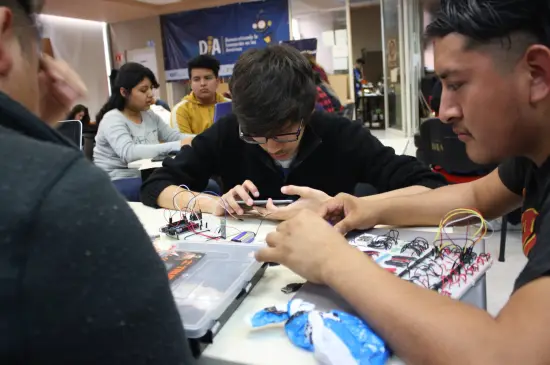
When Innovation is Accessible, the World gets closer to becoming inclusive Edel, an 18-year-old from Monterrey, Mexico, always dreamt of becoming a digital innovator and programmer to make a significant impact in the world. Edel, who has a hearing and speech disability, joined the DIA Innovation Lab in Mexico where he acquired new digital skills thanks to the Lab’s interpreters and its accessible equipment. His unique perspective to identify problems that could be solved with technology, enabled him and his team to launch an app that helps people with hearing disabilities receive notifications at airports to update them on their flights. This idea lead him and his team to win international recognition as they obtained top positions in competitions for innovation.   Edel’s story is an example of the importance of making digital skills and technological innovation accessible for people with disabilities. But, how many young adults are being left behind in the digitalization era? In the ever-changing world-of-work, the pace at which the digital transformation is taking place, may lead to exclude communities that have been historically overlooked. Now more than ever, it is possible to strive for creative solutions that bridge digital and skill gaps for those in vulnerable communities, such as people with disabilities. At The Trust for the Americas, we are committed to empower people with disabilities through the access, use and appropriation of technology and 21st century skills. This will enable them to be better prepared to compete in the Future of Work economy in Latin America and the Caribbean. In recognition of these efforts, the Zero Project, an initiative of the Austrian Essl Foundation, granted The Trust the Innovative Practice 2020 on Inclusive Education and ICT Award. This award recognizes The Trust’s accessible innovation lab “DIA (Democratizing Innovation in the Americas Inclusive Innovation Lab) in Santa Catarina, México. Problem Targeted at the DIA Inclusive Innovation Lab The DIA Lab in Santa Catarina, Mexico, operates in a context where more than 6% (291,000) of its population has a disability[1]. Youth with disabilities are often renegaded from educational opportunities because public schools do not provide nor have the capacities to provide accessible technology tools and equipment. Hence, leaving youth with disabilities at disadvantage compared to their peers, leading to social and educational exclusion and widening the digital gap for those with disabilities. Bridging the Digital and Innovation Gap for those with Disabilities In an effort to bring technology and innovation closer to people with disabilities, The Trust in alliance with the UTSC (Universidad Tecnológica Santa Catarina), created the first innovation Lab in Latin America that is accessible: the DIA Inclusive Innovation Lab. The Lab fosters inclusion and the democratization of technology in Mexico by providing youth, including those without disabilities, a space to acquire key vocational, digital and innovation skills. At the Lab, youth can materialize their ideas and create low-cost solutions and innovations through cutting-edge technology such as Arduinos, 3D printers, laser cutters, and Adapted Technologies. Access to the lab allows those with disabilities to do a wide array of activities, from doing their homework to coding their own websites or designing Android applications with Arduino technology. Breaking with the stigma that those with disabilities cannot manipulate technological tools, the DIA Lab provides state-of-the-art Adaptive Technology such as voice recognition programs, screen readers and screen enlargement applications, to help youth use computers and mobile devices. Since its creation in 2015, the lab has provided training to 2,000 at-risk young adults and has opened access to its resources to almost 14,000 people. An example of the kind of innovations created by participants in the lab is the Exo-chair, a low-cost technology kit that transforms a manual wheelchair into an electronic one. Influencing Public Policy In the public sphere, as an organization affiliated to the Organization of American States (OAS), The Trust has shared with the Department of Social Inclusion (DSI) the DIA Lab’s best practices and recommendations on accessibility. The DSI encourages member countries of the OAS, through its embassies, to incorporate such recommendations in their countries as public policy. Likewise, the DIA Inclusive Lab has raised awareness in the private and social sphere as it has participated in high level events throughout the continent. Most recently, the Lab participated in the Future of Work Event celebrated by The Trust for the Americas in alliance with Microsoft in Buenos Aires, Argentina. Furthermore, the DIA Inclusive Lab hosted a panel event at the first Innovation Summit ever celebrated in Latin America in the Caribbean. Organized by The Trust for the Americas and celebrated in Costa Rica, the DIA Inclusive Lab successfully utilized the Summit as a platform to share the importance of democratizing innovation and technology to those with disabilities. [1] According to INEGI (Instituto Nacional de Estadística y Geografía)

Accessibility and Innovation in the era of Digitalization Read More »

“In order to prevent violence against women, it is fundamental to identify it in a timely manner”: Specialist

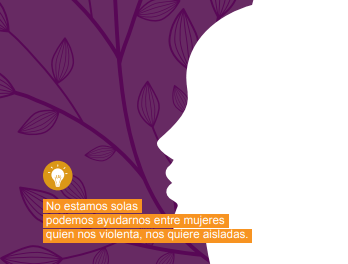
The National Institute of Statistics and Geography (INEGI, for its Spanish name) informed that in Mexico during 2019 more than 66% of women had experienced at least one type of violence. Olga Sánchez Cordero, Secretary of the Interior (SEGOB in Mexico), emphasized that despite the important efforts for labor equality, it has not been reached yet. “According to the OCDE, we have a 30% difference in remuneration between men and women. This inequality also causes an unequal distribution of domestic work and we have to advocate for this equitable distribution and for parental care” asserted the Secretary. Recently, during the confinement measures taken in response to Covid-19, there has been an increase in the distress calls regarding family violence as reported by the 911 service of response and support in Mexico. Considering this scenario, The Trust for the Americas, through the VIVE Project, launched a digital course “Prevention of violence against women and girls” which will be available in the Virtual Classroom free of charge thanks to the support of The Walmart Foundation. In an interview with Alma Burciaga, independent consultor and creator of contents for the online course, held through Facebook Live, she stated that a fundamental step in the prevention of violence is being able to identify it in a timely manner, hence, the course uses an accessible and easy-to-understand language and describes the different types of violence. “This course will help us realize the different ways violence can be manifested. It is so normalized that we do not know we are living violence and we can find it in both public spaces like the workplace, streets, markets, schools, etc. and in private spaces, which could even be our own homes. Even before birth, we are already labeled” explained Ms. Burciaga. According to the Interamerican Convention to Prevent, Sanction and Eradicate Violence against Women, better-known as Convención de Belém do Pará,  violence against women is defined as “that violence against women constitutes a violation of the human rights and fundamental liberties, and totally or partially limits women in their recognition, enjoyment and exercise of said rights and liberties; given that violence against women is an offence against human dignity and a manifestation of the historically unequal power relationships between women and Man, act or omission based in gender, that causes physical, psychological, patrimonial, economic and/or sexual damage or suffering or even death; both in the public and private spheres”. Even though the topic was added to the training curriculum of VIVE in 2018, “This is a completely new course” according to Alma Burciaga. “I really put an effort into finding new videos and materials relevant to current events. I also tried to include the context of the global pandemic caused by COVID-19. In the course you can find the following topics: Gender roles, Stereotypes, How a violent person behaves, How I feel when being violated, The Cycle of Violence, and descriptions of Psychological Violence amongst others.” The 10-hour course is now available in Spanish at https://aulavirtual.trustfortheamericas.org/ and people who successfully complete it can acquire a participation diploma. About the VIVE Project: VIVE Project: VIVE in Spanish means “Come, be inspired and sell”. The Walmart Foundation supports this project implemented in Mexico by The Trust for the Americas, in partnership with the ManpowerGroup Foundation. Since 2016, VIVE seeks to increase the economic empowerment of Mexican women through training in technical skills such as sales, retail, customer service, and life skills like entrepreneurship, effective communication and leadership. The training is aimed at low-income women over 15 years old from communities in vulnerable situations. VIVE has had a presence in 184 municipalities, in 28 Mexican states. During 2018, The Trust added to the curriculum the course on prevention of violence against girls and women. In this way, the project’s objective is that participants increase their chances of accessing formal economic opportunities in these areas, as well as helping to prevent gender violence. About Walmart:  Together, Walmart and the Walmart Foundation generally provide more than $1 billion in cash and in-kind to support programs that align with its philanthropic priorities. Walmart Foundation focuses on areas where they can do the most good – combining the unique strengths of the business alongside philanthropy. The ability to draw on Walmart’s business strengths, providing more than just funding, helps Walmart’s philanthropy to deliver greater societal impact. Today, Walmart.org, through the combined philanthropic efforts of both Walmart and the Walmart Foundation, creates opportunities for people to live better every day.

“In order to prevent violence against women, it is fundamental to identify it in a timely manner”: Specialist Read More »

“Fundamental, para prevenir la violencia hacia las mujeres es necesario identificarla de forma oportuna”: especialista

En México, el Instituto Nacional de Estadística y Geografía (INEGI) informó que para finales de 2019 más del 66% de las mujeres había vivido algún tipo de violencia. Por su parte, Olga Sánchez Cordero, Secretaria de Gobernación (SEGOB), destacó que mucho se ha luchado por la igualdad laboral, pero todavía no la hemos logrado. “Tenemos un 30% menos según la OCDE (Organización para la Cooperación y el Desarrollo Económicos) de remuneración para las mujeres en diferencia con los hombres. Esta desigualdad provoca también una distribución inequitativa de las labores domésticas y tenemos que propugnar por esta distribución equitativa y por el cuidado parental”, afirmó la titular de SEGOB. Recientemente, ante el confinamiento por el Covid-19 incrementaron las llamadas de auxilio por temas relacionados a la violencia intrafamiliar, así lo reportó el servicio de atención y apoyo 911 en México. Ante este panorama, The Trust for the Amercias, a través del Proyecto VIVE, lanzó el curso digital “Prevención de violencia hacia las niñas y las mujeres” que estará disponible en el aula virtual de forma gratuita gracias al apoyo de Walmart Foundation. En entrevista por Facebook Live con Alma Burciaga, consultora independiente y creadora de contenidos para el curso virtual, indicó que un paso fundamental en la prevención de la violencia es identificarla de forma oportuna, por ello el curso está diseñado en un lenguaje accesible y de fácil comprensión donde se describen los tipos de violencia. “Este curso nos ayudará a darnos cuenta de las diferentes manifestaciones de la violencia. Está tan normalizada que se nos va que estamos viviendo violencia y la podemos encontrar en lo público como son: espacios laborales, calles, mercados, escuelas, etc; y en lo privado, que pueden ser nuestros propios hogares. Es más, desde antes del nacimiento ya se nos ponen etiquetas.” destacó Burciaga. De acuerdo con la Convención Interamericana para Prevenir, Sancionar y Erradicar la Violencia contra la Mujer, conocida como Convención de Belém do Pará,la violencia hacia las mujeres se define como “que la violencia contra la mujer constituye una violación de los derechos humanos y las libertades fundamentales y limita total o parcialmente a la mujer el reconocimiento, goce y ejercicio de tales derechos y libertades; porque la violencia contra la mujer es una ofensa a la dignidad humana y una manifestación de las relaciones de poder históricamente desiguales entre mujeres y hombres; acto u omisión basada en su género, que le cause daño o sufrimiento psicológico físico, patrimonial, económico, sexual o la muerte; tanto en ámbito público como privado”. Aunque el tema se sumó al curriculum de capacitación del Proyecto VIVE en 2018, “este curso viene completamente nuevo, dijo Alma Burciaga. “Me esforcé en buscar vídeos y materiales nuevos y actuales. Además traté de ponerlo en contexto de la pandemia sanitaria por el COVID-19. Las personas encontrarán los temas de:  Roles de género; Estereotipos; Cómo se comporta una persona violenta; Cómo me siento cuando soy violentada; El Ciclo de la violencia y descripciones de la Violencia psicológica, entre otros”. Actualmente, el curso está disponible en https://aulavirtual.trustfortheamericas.org/ y consta de 10 horas, al término del mismo las personas interesadas podrán acceder a una constancia de participación. Además tenemos disponible el Manual de Prevención de Violencia hacia las niñas y las mujeres, que es una guía para conocer más del tema e identificarla en todas sus formas. Sobre el Proyecto VIVE El Proyecto VIVE: ven, inspírate y vende, se implementó en México por The Trust for the Americas en alianza con Fundación ManpowerGroup y con el apoyo de Walmart Foundation de Estados Unidos. En 2016, Proyecto VIVE inició con el objetivo de impulsar el empoderamiento económico de las mujeres mexicanas a través de la capacitación en habilidades técnicas: ventas, promotoría, atención al cliente y habilidades para la vida como: emprendimiento, comunicación efectiva y liderazgo. La capacitación esta dirigida a mujeres mayores de 15 años que se encuentren en una situación de vulnerabilidad. VIVE ha tenido presencia en 184 municipios, en 28 estados de México. Durante 2018, The Trust for the Americas sumó al curriculum de VIVE el curso de prevención de violencia hacia las niñas y las mujeres. Sobre Walmart Foundation:   Juntos Walmart y Walmart Foundation generalmente proporcionan más de $1 billón en efectivo y en especie para apoyar programas que se alinean con sus prioridades filantrópicas. Walmart Foundation se enfoca en áreas donde pueden hacer el bien – combinando las fortalezas únicas del negocio junto con la filantropía. Walmart Foundation ofrecer un mayor impacto social. Hoy, Walmart.org, a través de los esfuerzos filantrópicos combinados de Walmart y la Walmart Foundation crea oportunidades para que las personas vivan mejor cada día.

“Fundamental, para prevenir la violencia hacia las mujeres es necesario identificarla de forma oportuna”: especialista Read More »

The VIVE-Trust Talent Bank Promotes Employability in Difficult Times

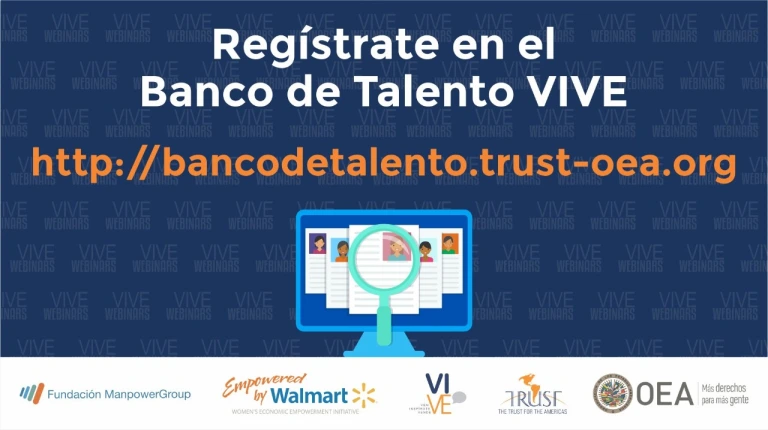
The VIVE Project was launched in Mexico with support from the Walmart Foundation; to date, it has trained more than 54,000 Mexican women in technical and life skills to help them secure better economic opportunities. We have helped nearly 20% of our graduates find a job or start their own business. However, in March 2020, we faced a global challenge that led us to rethink both our training program and the strategy through which we could provide additional support to our community—all without direct or in-person contact with either the beneficiaries or our partner organizations. In response to the COVID-19 crisis, VIVE migrated all its activities to accessible virtual platforms; we incorporated the use of social media to foster direct interaction with participants and designed Monitoring and Evaluation strategies to guide our plans. Thanks to the surveys we conducted, we discovered that one of the most pressing challenges for our community of graduates is the negative impact that the contraction of the national economy is having on their families. According to official data, more than one million jobs were lost throughout Mexico starting in March. Furthermore, the business sector has been severely affected, particularly micro and small businesses, many of which have been forced out of the market. To strengthen the employability component, Proyecto VIVE created a Talent Bank that will compile relevant information on the needs and profiles of our graduates in order to connect them with potential employers and provide them with guidance during the selection process. The VIVE-Trust Talent Bank was launched at a virtual event on July 9 via the project’s official Facebook page (@ProyectoVIVEMx). The event featured a tutorial video showing the registration process step by step, as well as an invitation to all women to join VIVE and take advantage of this and other tools. In addition, the first video from the Virtual Job Fair—a complement to the talent bank—was presented, featuring information on the recruitment process at Manpower Group. The event featured Eduardo Almanza, Regional Manager of Training and Employability at Manpower Group, a key partner of the VIVE Project. Eduardo Almanza assured the audience of more than 160 people that jobs are indeed available during the pandemic and that most companies are working closely with governments to ensure a safe return to economic activity. He also emphasized that VIVE’s training programs meet the needs and expectations of the labor market, as employers are seeking individuals with developed life skills, such as leadership and teamwork. Almanza also reflected on the gender gap in the labor market and how confidence is key for women to land the jobs we want. She therefore advised women to learn to recognize their own efforts, identify opportunities aligned with their interests, and above all, to go out and give it a try, since the only way to achieve our goals is by trying as many times as necessary. The full interview is available on our YouTube channel. Registration for the VIVE-Trust Talent Bank is completely free and voluntary and can be completed by clicking on the following link: http://bancodetalento.trust-oea.org/ The only requirement is that the interested individual be a graduate of any VIVE training course, including those in our Virtual Classroom. For more information on how to register, or if you’re interested in joining the project as an employer, please email us at oportunidades@20.9.190.97 About the VIVE Project The VIVE Project: Come, Be Inspired, and Sell was launched in Mexico by The Trust for the Americas in partnership with the ManpowerGroup Foundation and with support from the Walmart Foundation in the United States. In 2016, the VIVE Project was launched with the goal of promoting the economic empowerment of Mexican women through training in technical skills—such as sales, promotion, and customer service—as well as life skills, including entrepreneurship, effective communication, and leadership. The training is aimed at women over the age of 15 who are in vulnerable situations. VIVE has operated in 184 municipalities across 28 states in Mexico. In 2018, The Trust for the Americas added a course on the prevention of violence against girls and women to the VIVE curriculum. About the Walmart Foundation: Together, Walmart and the Walmart Foundation typically provide more than $1 trillion in cash and in-kind contributions to support programs that align with their philanthropic priorities. The Walmart Foundation focuses on areas where it can do good—combining the unique strengths of the business with philanthropy. The Walmart Foundation aims to create greater social impact. Today, Walmart.org, through the combined philanthropic efforts of Walmart and the Walmart Foundation, creates opportunities for people to live better every day.

The VIVE-Trust Talent Bank Promotes Employability in Difficult Times Read More »