
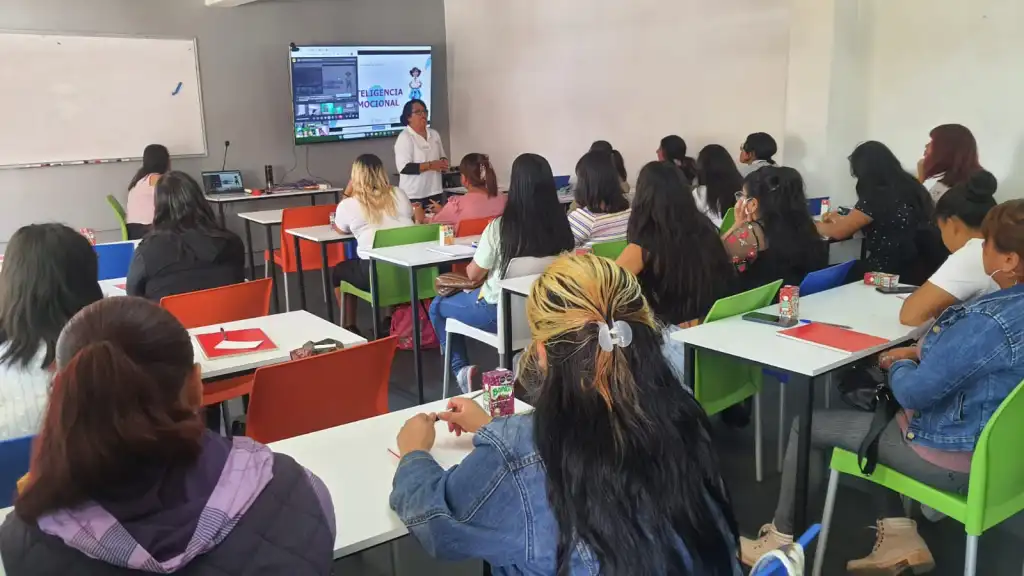
The women participating in the CIMA Project (Comprehensive Training for Women in Action), implemented by The Trust for the Americas in partnership with Jóvenes Constructores de la Comunidad (JCC) and the Centro Laboral Mexicano (CELAMEX), have successfully completed the Workshop on Care and Shared Responsibility for the Advancement of Women’s Economic Rights. This training was led by Beatriz Piñeres, a specialist with the Inter-American Commission of Women (CIM), and represented a significant step toward promoting gender equality and strengthening women’s economic rights.
During the workshop, fundamental topics related to caregiving, gender roles and stereotypes, the definition of the concept of care, and the effects of inequality in the distribution of care work were addressed. The participants also explored the guiding principles of care as a fundamental right, in addition to acquiring practical tools for the co-responsible redistribution of care. The session concluded with a reflection on concrete actions to balance family, work, and personal life.
The Inter-American Commission of Women (CIM), as a pioneer in the defense of women's rights, deployed its expertise through the facilitation of this workshop. Founded in 1928 as the world's first intergovernmental body dedicated to the recognition and defense of women's rights, the CIM has been a driving force in building the women's rights agenda in the region.
Currently, The Trust for the Americas has joined forces with the CIM to continue the work in the fight for gender equality, bringing women’s voices and agenda to the forefront of international politics. The CIM Assembly of Delegates, composed of the 34 ministers for women’s affairs from across the continent or the senior officials responsible for gender issues in each OAS member state, stands as the preeminent political forum for women’s rights.
This workshop represents a milestone in the joint commitment to advance toward more equitable and just societies. The women participating in the CIMA Project, empowered by the knowledge acquired, position themselves as agents of change in the promotion of women's economic rights and the transformation of gender dynamics.